



Airway-Focused Dentistry for Children and Adults Explained
· By Wholistic Dental Care · 7 min read
Summary: Airway-focused dentistry for children and adults involves identifying dental signs that may indicate breathing issues, such as tongue posture and jaw position, and coordinating with medical professionals for accurate diagnosis and treatment. It emphasizes screening over immediate appliance use, ensuring that dental findings guide appropriate medical referrals, particularly for conditions like sleep apnea.
When a child snores all night, or an adult wakes up with a dry mouth, people often reach for the same advice: buy a mouth guard, wait for braces, or ask the dentist for a quick fix. That advice falls apart when breathing, tongue posture, jaw growth, and sleep are treated as separate problems.
Airway-focused dentistry looks at how the mouth, jaw, and tongue affect breathing and sleep, at every age. It should start with screening and coordination. It should not promise that an appliance will cure sleep apnea or guarantee a child's development.
Dentists see the mouth regularly, which puts us in a good position to spot early signs. At Wholistic Dental Care in Mukilteo, we screen every patient's airway, and we work alongside pediatricians, ENTs, and sleep specialists when more support is needed.
What should airway-focused dentistry actually do?
It should separate dental clues from medical diagnosis before any treatment starts. A child with mouth breathing and crowded teeth needs a different path than an adult with morning headaches and clenching, even though both concerns can show up in the dental chair.
As dentists, we can look for signs and refer you for testing. Sleep apnea can only be diagnosed by a physician, through a sleep study.
What signs make a child's dental visit an airway visit?
If several of these sound familiar, an airway assessment is a good next step:
- Restless sleep, frequent waking, or bedwetting
- Snoring or noisy breathing at night
- Breathing through the mouth, especially during sleep
- Dark circles under the eyes
- Grinding teeth at night
- Crowded or crooked teeth
- Tongue thrust or thumb sucking past early childhood
- Daytime tiredness, difficulty focusing, or irritability
One sign doesn't prove a problem. Several together are worth looking into.
The reason to ask early is growth. How a child breathes, swallows, and rests their tongue shapes how their face and jaws grow. Mouth breathing, a low tongue posture, or thumb sucking can contribute to narrow jaws and crowded teeth, and these same patterns are often linked to restless sleep. Chronic mouth breathing is also associated with poorer sleep and gum inflammation.
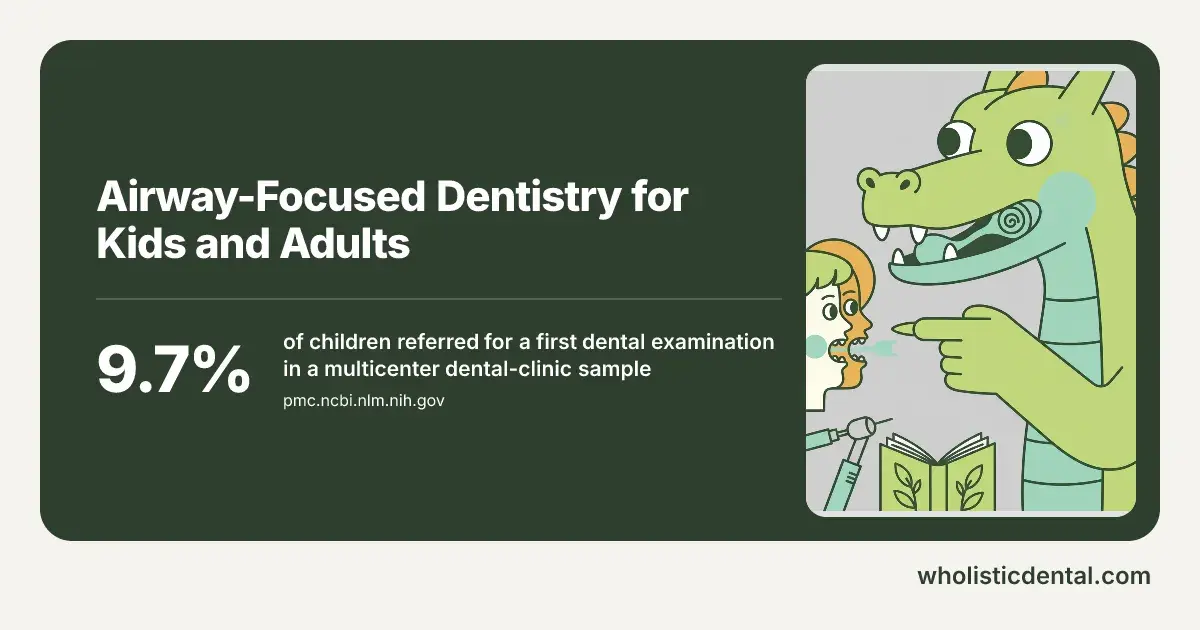
Research supports taking this seriously. A 2020 study in the International Journal of Environmental Research and Public Health found sleep-related breathing disorders in 9.7% of children referred for a first dental examination.
At an airway and growth assessment, we look at your child's teeth, jaws, tongue, lips, and breathing habits. Low-radiation 3D imaging can help us assess the airway where appropriate. Some children benefit from an ENT evaluation, for example for enlarged tonsils or adenoids, or from a sleep study or a tongue-tie release, and we coordinate this with you.
How Myobrace fits in
Myobrace is a pre-orthodontic system that addresses some of the causes of crooked teeth and poor jaw development, rather than only straightening teeth. It isn't a replacement for braces or a guaranteed way to prevent sleep-disordered breathing.
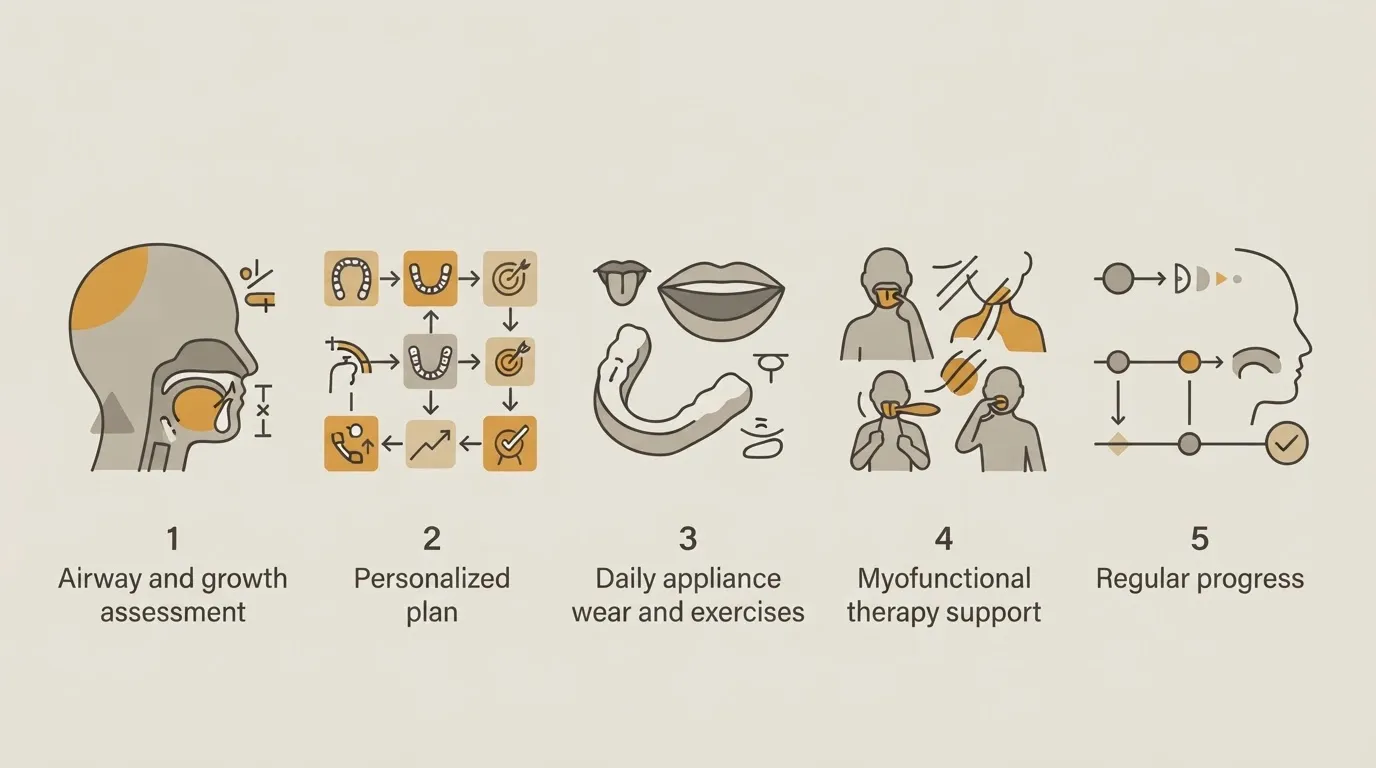
It combines soft, flexible appliances worn for an hour or two during the day and overnight while sleeping, with daily activities and exercises to retrain the tongue, lips, and breathing. The aim is to encourage nasal breathing, correct tongue posture, and proper swallowing, which in turn supports natural jaw growth and space for adult teeth.
Myobrace works best while children are still growing. Results depend a lot on consistent daily use and practice, so we look for families ready to commit together. If it's a good fit, we'll explain the appliance stages, daily routine, and expected timeline, and your child will visit us regularly to check progress and keep their motivation up. When families commit, many children see improvements in breathing habits, tongue posture, and tooth alignment. Results vary, and some children will still need orthodontics later.
Before starting, a family should know:
- What pattern we're addressing, such as mouth breathing, low tongue posture, tongue thrust, or thumb sucking.
- Whether the daily routine is realistic for your household.
- When tonsils, adenoids, a tongue tie, or possible sleep-disordered breathing need medical evaluation.
- What the end point looks like, since some children still need orthodontics later.
Myofunctional therapy is often part of the picture. Our hygienist Kassy is certified in myofunctional therapy and helps children and adults identify and correct oral habits that affect breathing, swallowing, sleep, and facial development, using targeted exercises.
What changes for adults?
Snoring, waking up tired, morning headaches, a dry mouth, or clenching at night can all be signs that your airway is struggling while you sleep. We look for these signs at every comprehensive exam. They are clues, not a diagnosis.
If we see signs of sleep-disordered breathing, we'll refer you for a sleep study, at home or in a sleep lab, and work alongside your doctor and sleep specialists.
From there, your options may include:
- A custom oral sleep appliance. This is different from a protective night guard. It's worn at night and gently holds your lower jaw forward to help keep your airway open. It can reduce snoring and, once a physician has diagnosed it, is an option for many people with mild to moderate sleep apnea. We make each appliance from a digital scan, with no impressions.
- NightLase. This gentle, non-invasive Fotona laser treatment tightens soft tissue at the back of the mouth and throat to help reduce snoring. There's no surgery, no anesthesia, and nothing to wear. Many people notice improvement, and results usually last several months, with maintenance sessions available.
- Myofunctional therapy. Kassy helps adults retrain tongue posture, swallowing, and breathing habits that can affect sleep and jaw comfort.
- A night guard. A guard can protect your teeth from grinding and support jaw comfort, but it isn't a treatment for sleep apnea.
Neither an appliance nor laser treatment should be used to skip a diagnosis when sleep apnea is a concern.
Where does 3D imaging fit?
Low-radiation 3D imaging can help us see the airway, sinuses, joints, and bone where appropriate. It's one part of an assessment, not a test for sleep apnea. The American Association of Orthodontists' 2026 white paper update says current evidence doesn't support craniofacial imaging as a reliable screening or diagnostic test for sleep-disordered breathing, and doesn't support orthodontic procedures as a way to prevent it. That's why we don't treat a narrow arch or a scan as a diagnosis, and why we refer you for medical evaluation when sleep-disordered breathing is suspected.
How should a first airway appointment start?
Your first visit begins with a comprehensive exam, a sleep and breathing history, and a clear list of what's happening at home. Parents can bring notes about snoring, mouth breathing, bedwetting, grinding, restless sleep, thumb sucking, focus at school, and daytime mood. Adults can bring notes about snoring, dry mouth, headaches, clenching, and sleep quality.
Good questions to ask at the visit:
- Which airway signs did the exam find today?
- Which symptoms would justify a referral to a pediatrician, ENT, or sleep specialist?
- Is imaging needed, or can that decision wait?
- Would myofunctional therapy be useful before an appliance?
- For a child, what daily Myobrace routine would we need to maintain?
- For an adult, what would send us toward a sleep study first?
You should leave knowing what happens next and who is responsible for each step. We screen and treat dental contributors, a physician diagnoses sleep apnea, and the daily habits happen at home.
When to seek prompt medical care
See a physician promptly, rather than starting with a dental appointment, if an adult has witnessed pauses in breathing, severe daytime sleepiness, or medical risk factors. For a child with loud snoring, noisy breathing, or restless sleep, your pediatrician should be part of the plan. We're glad to share records and oral findings with your medical team.
Let's help you breathe, sleep, and grow well
Book an airway assessment for your child or for yourself. Call 425-599-5475 or email info@wholisticdental.com.
Frequently asked questions
Can a dentist diagnose sleep apnea?
No. Sleep apnea is diagnosed by a physician through a sleep study. Dentists can screen for signs and refer you for testing.
Is mouth breathing bad for kids?
Chronic mouth breathing is associated with narrow jaws, crowded teeth, poorer sleep, and gum inflammation. It's worth having it assessed.
Is Myobrace better than braces?
They do different jobs. Braces straighten teeth. Myobrace aims to address the habits that affect jaw growth and alignment. Some children use both at different stages.
Does NightLase stop snoring?
NightLase is designed to reduce snoring by tightening soft tissue in the throat. Many people notice improvement, and results usually last several months, with maintenance sessions available.
Sources
- International Journal of Environmental Research and Public Health: Prevalence of Sleep-Disordered Breathing in Children Referring for First Dental Examination (2020)
- American Association of Orthodontists: Sleep-disordered Breathing and Orthodontics, White Paper Update