




Ceramic Zirconia Implants vs Titanium: How to Choose
· By Wholistic Dental Care · 9 min read
Summary: Ceramic zirconia implants offer a metal-free, aesthetically pleasing alternative to titanium implants, which have a longer clinical history and are considered the gold standard for predictability. Zirconia is suitable for patients prioritizing metal-free options or those with thin gum tissue, while titanium is ideal for those seeking a well-documented, reliable choice. Both materials rely on bone integration for stability.
Your dentist tells you a tooth can't be saved. That one conversation moves you away from a routine filling or crown and toward an extraction, possibly a bone graft, and an implant placed in your jaw. Once a post goes into bone, what it's made of matters far more than it did when the problem was on the surface of a tooth.
Ceramic zirconia and titanium do the same job: they replace a missing tooth root. They answer different priorities, though. Titanium suits people who want decades of clinical history. Zirconia suits people who want a metal-free root replacement that fits a biological approach to extraction, healing, and the final crown.
No single material is right for every mouth. Titanium is the most heavily studied option. Ceramic zirconia offers real value to people who want to avoid metal, have thin gum tissue near the smile line, or center their dental care on biocompatible materials.
Ceramic zirconia implants vs titanium: what actually changes?
The material changes what can show through your gums, whether there is metal in your jaw, and how many years of research sit behind the choice. Titanium is a metal alloy with a long, successful track record. Zirconia is a white ceramic made from zirconium dioxide.
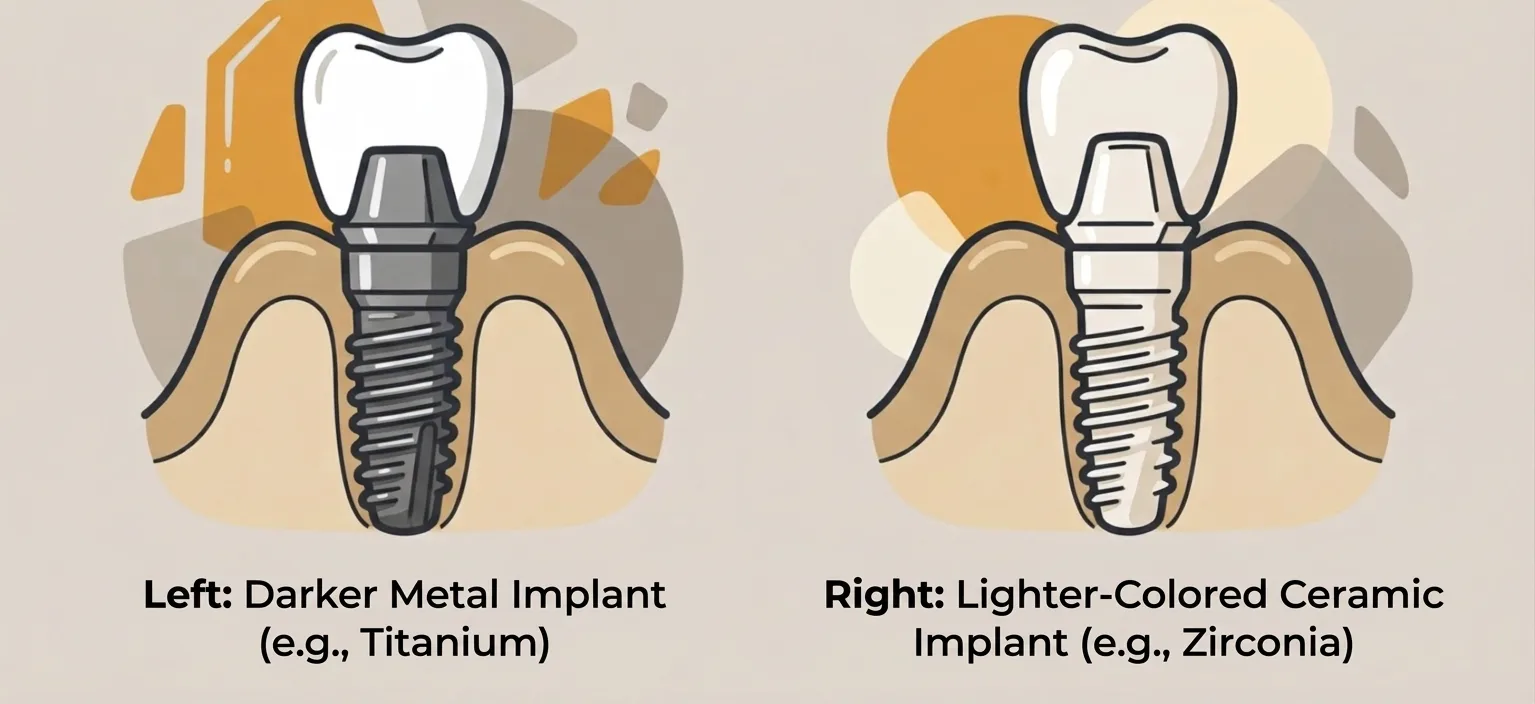
Both work the same basic way. Bone grows tightly against the surface of the implant until it's anchored firmly enough to hold a crown.
| Decision point | Titanium implant | Ceramic zirconia implant |
|---|---|---|
| Material | Metal alloy | Metal-free ceramic made from zirconium dioxide |
| Color near the gumline | Grey, which can show through thin gum tissue | White and tooth-like, with no grey show-through |
| Evidence | A May 2026 overview of reviews found titanium remains the gold standard for predictability | The same overview described zirconia as a viable alternative in esthetically demanding cases |
| Longer-term comparison | A systematic review of randomized trials reported survival over 95% after 10 years | The same review reported survival of 87-100% over 1-8 years |
| Best fit | Patients who want the longest track record and don't object to metal | Patients who want a metal-free option, have metal sensitivity concerns, or want a natural look on a front tooth |
Zirconia is about more than appearance. Many of our patients ask about it because they prefer to keep metal out of their bodies, and they want the implant and the crown on top of it to reflect that.
Titanium deserves the same honesty. If you want the deepest possible body of clinical evidence, titanium has decades more data behind it. A preference for metal-free dentistry doesn't erase that difference, and it's why we look at your bone, gums, bite, and overall health before recommending anything.
What does the research say now?
Zirconia has become a serious option, and titanium still has the deeper record.
A May 2026 peer-reviewed overview of reviews concluded that titanium remains the gold standard for long-term predictability, while zirconia is a viable alternative in esthetically demanding cases. A 2023 systematic review and meta-analysis found no significant difference in survival between zirconia and titanium implants at 12 months. Similar short-term results are encouraging, but an implant is a long-term decision, and longer follow-up data for zirconia is still being collected.
A May 2026 summary published by the implant manufacturer Swiss Dental Solutions reported comparable clinical outcomes in a meta-analysis. A manufacturer's summary shouldn't carry the same weight as an independent trial, so we treat it as one more piece of a growing picture.
None of this supports fear-based claims about titanium. Titanium has served many patients well. The strongest case for zirconia is that a metal-free implant is now a reasonable, increasingly studied choice for patients whose values, gumline, or material sensitivities point that way.
How extraction and healing affect your implant
The condition of the extraction site matters as much as the implant material. No implant settles well in poor conditions.
When a tooth needs to come out, we remove it gently and use multiple techniques to make sure the tooth, the periodontal ligament, and any infection are fully removed. We manage pain, inflammation, anxiety, and healing throughout. We use platelet-rich fibrin (PRF) and platelet-rich plasma (PRP) from your own blood in all of our surgical procedures, along with ozone to support healing. After a thorough clean-up of the site, we use a mineral bone graft when one is needed.
We treat all of this as one continuous plan, from careful extraction and bone preservation through to your final crown. We place SDS ceramic implants as part of that plan, so an implant is never a one-off procedure.
Some patients can have an implant placed on the same day as an extraction. Others need a healing period first. Ceramic implants generally need a few months to integrate with the bone. Once healed, we scan your mouth digitally, with no goopy impressions, and fit your metal-free crown.
We use low-radiation 3D CBCT imaging to look at your bone, sinuses, and nearby structures. We also check for signs of infection or poor healing at old extraction or root canal sites. This is where many biological cases begin.
We don't offer root canal treatment at our office. If a root canal is your preference, we have endodontists we're glad to refer you to.
Who is each material best suited for?
Zirconia may suit you if you:
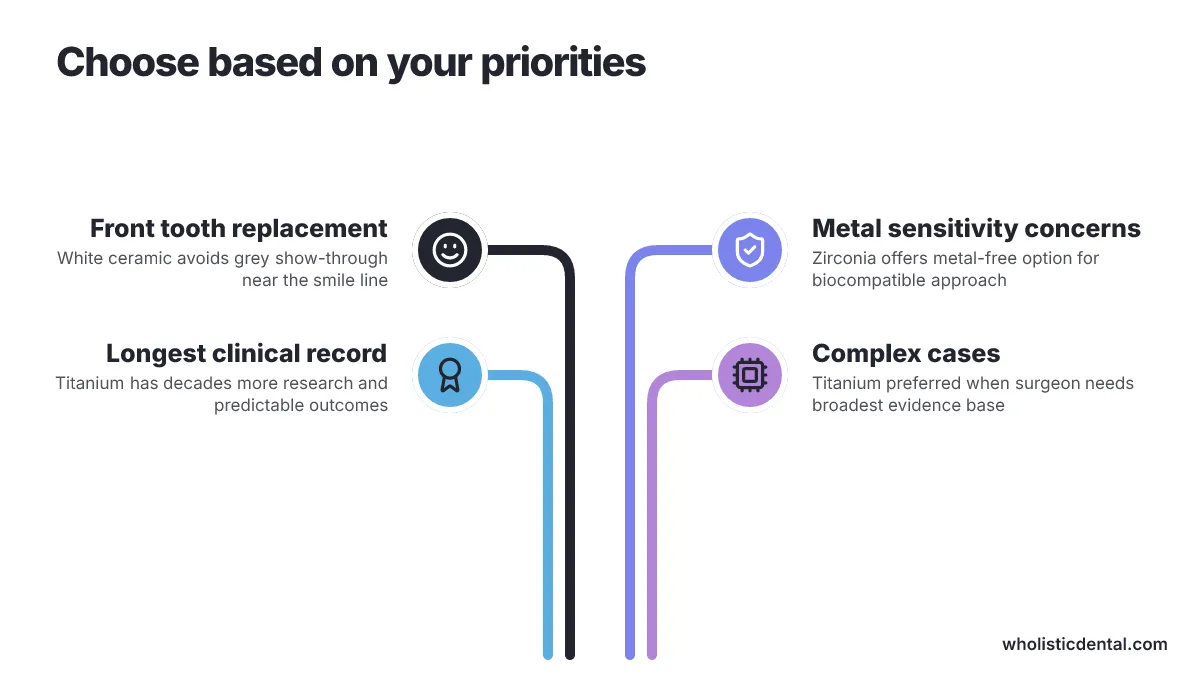
- Want to avoid metal in your body for health or personal reasons.
- Have a known or suspected sensitivity to metals.
- Are replacing a front tooth and want the most natural look at the gumline.
- Have had amalgam fillings removed and want a fully metal-free mouth.
- Are working with a naturopath or physician on reducing metal exposure.
Titanium may suit you if you want the longest clinical record, have no concerns about a metal implant, and grey show-through isn't an issue where the implant will sit.
If you have a known or suspected metal sensitivity, Biocomp Labs blood testing is one way to bring information specific to you into the planning.
If you grind your teeth, have limited bone, or have active gum inflammation, we'll need a broader conversation before either material is chosen. Zirconia is strong, but success still depends on bite forces, hygiene, bone support, and the design of the crown. A night guard, if you grind, helps protect your implant.
Dr. Kayleigh Short understands this decision from both sides of the chair. As part of her own dental revitalization, she chose to remove infected root canal teeth, clear underlying bone infection, and place biocompatible ceramic implants. Her experience isn't clinical proof, but it does mean she knows how this feels.
What happens at a biological implant consultation?
We start by listening. We'll talk through your symptoms, your health history, and what you want for your long-term health, and we'll look closely at whether the tooth really needs to go.
From there, your plan may include the extraction, clearing the site, PRF and ozone, a bone graft if needed, healing time, placing the implant, time for the implant to integrate with the bone, a digital scan, and finally a metal-free ceramic crown. The order depends on your tooth and your healing, and we'll tell you which steps could change along the way.
The crown matters from the start. We use metal-free ceramic crowns on our ceramic implants, so the whole restoration matches the reason you chose zirconia.
If past dental experiences make you anxious, tell us. Managing pain, swelling, and how you feel in the chair is part of how we plan your care.
How to choose between zirconia and titanium
Start with the diagnosis rather than the implant. A complete evaluation should tell you whether the tooth can be saved, whether infection or bone loss complicates removing it, and whether an implant can be placed right away or needs to wait.
If you want a metal-free restoration, ask about SDS ceramic implants, PRF, ozone, grafting, and the crown that goes on top. If you lean toward the option with the longest history, ask what the titanium data means for your specific tooth.
To find out whether ceramic implants are right for you, call us at 425-599-5475 or email info@wholisticdental.com to book a consultation.
When to seek prompt care after extraction or implant surgery
Whichever material you choose, contact the dental office that treated you, or urgent care if the office is closed, if you notice bleeding that won't stop with pressure, swelling that keeps getting worse, fever, pus or a bad taste from the site, numbness that doesn't wear off, or pain that increases instead of easing. These signs should be checked rather than waited out.
Frequently asked questions
What are the main differences between ceramic zirconia and titanium implants?
Zirconia implants are metal-free and white, which helps at the gumline, especially with thin gum tissue. Titanium implants are a metal alloy with a much longer clinical history. Both rely on bonding with the bone.
Are ceramic zirconia implants as reliable as titanium implants?
Titanium has more long-term data.Zirconia is a viable alternative, and its evidence base continues to grow. Neither is "better" for everyone.
Are zirconia implants FDA approved?
Several ceramic implant systems are FDA-cleared for use in the United States, including the SDS implants we use.
Can I replace a titanium implant with zirconia?
In some cases, yes. It depends on the implant's condition and the surrounding bone, which we'll assess with 3D imaging. We don't remove metal implants at our office, so we'll refer you to a trusted dentist who specializes in metal implant removal.
How much do ceramic implants cost?
Ceramic implants are comparable in cost to titanium. Your cost will depend on extraction, grafting, and the crown. We're a fee-for-service office and provide superbills for out-of-network insurance benefits.
Can a zirconia implant still contain metal?
The implant itself can be metal-free, but the crown matters too. We use metal-free ceramic crowns on our ceramic implants.
Sources
- PMC: Survival and success of zirconia compared with titanium implants: a systematic review and meta-analysis
- PMC: Clinical Performance Comparing Titanium and Titanium-Zirconium or Zirconia Dental Implants: Systematic Review of RCTs
- Swiss Dental Solutions (manufacturer blog): Study of the Month, May 2026: Zirconia vs. Titanium, Meta-Analysis Reports Comparable Clinical Outcomes
- PMC: Comparative Evaluation of Titanium Versus Zirconia Implants for Their Clinical Outcomes: An Overview of Reviews